For years, my job description was: seagull.
Fly into a project review, make some noise, drop an opinion on everyone, fly off to the next project: seagull management.
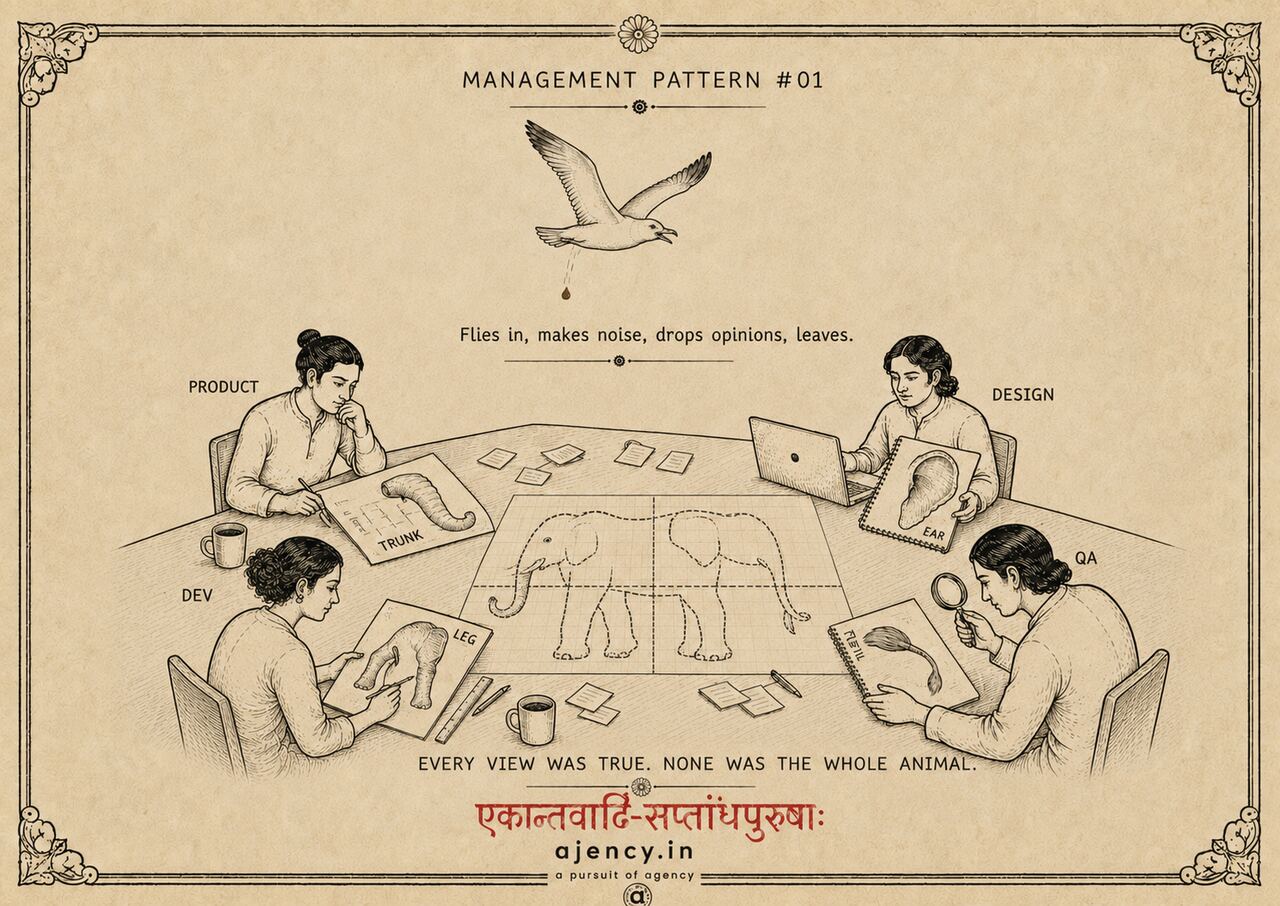
It was the only way the structure worked. I ran multiple teams across multiple clients. Clients came to us in part for my experience, and I tried to bring it to every project. Spread across that many teams, “bringing it” meant an hour of oversight here, a review there, and off to the next one.
Seagull management
Not my coinage. Ken Blanchard, Leadership and the One Minute Manager (1985): seagull managers fly in, make a lot of noise, dump on everyone, and fly out.
Blind men, one elephant
And inside every one of those teams, the old Indian fable of the blind men and the elephant was playing out: product held the trunk, design the ear, dev a leg, QA the tail. Every view was true, and none was the whole animal, so the software shipped with the seams showing.
About the fable
Older than management theory: the parable appears in Buddhist, Jain, and Hindu texts. The Jain schools turned it into a doctrine — anekantavada, the many-sidedness of truth.
We fixed it the only way we knew, with more documents, more standups, more handoffs, which only added more ways to mishear each other.
A new way of working
Then AI agents made a new way of working possible.
The work is the same as it's always been: understand a problem, build the thing that solves it. What changed is who I hand the pieces to. Instead of splitting a project across a team, I split my day across skills: discovery, designing workflows, building, reviewing.
I could always do every role; what I never had was the economics: my time cost a multiple of a developer's, and alone, a build like that would have taken years. The team was the only arithmetic that worked. Agents changed the arithmetic.
The first project
The first project built this way was a full ERP implementation for a ₹500-crore-plus automobile dealer: cash register, reconciliation with the carmaker's dealer management system, auto-ingestion into Tally, bank and card/UPI merchant recon, reports, a business dashboard, taken from discovery to delivery in four months. Every role in that sentence was me, including the QA agent that documented its own testing.
In my old structure, that's a six-person team and the better part of a year. And I'd have seagulled it.
Clients have always handed me the whole problem. Before, I solved it with a team, and my experience reached each project an hour at a time. Now my full experience shows up on one project, end to end, with a bench of agents doing the hands' work.

The elephant stays whole, because one mind finally holds all of it.
Get the next post by email.
I publish slowly. You’ll get an email when something new is up.