At closing, the day's cash doesn't go into a safe; it goes home with a man everyone calls Mama ji. He brings part of it back tomorrow and the rest a few days later. He's been doing this for twenty years.
Software has one word for this arrangement: discrepancy.
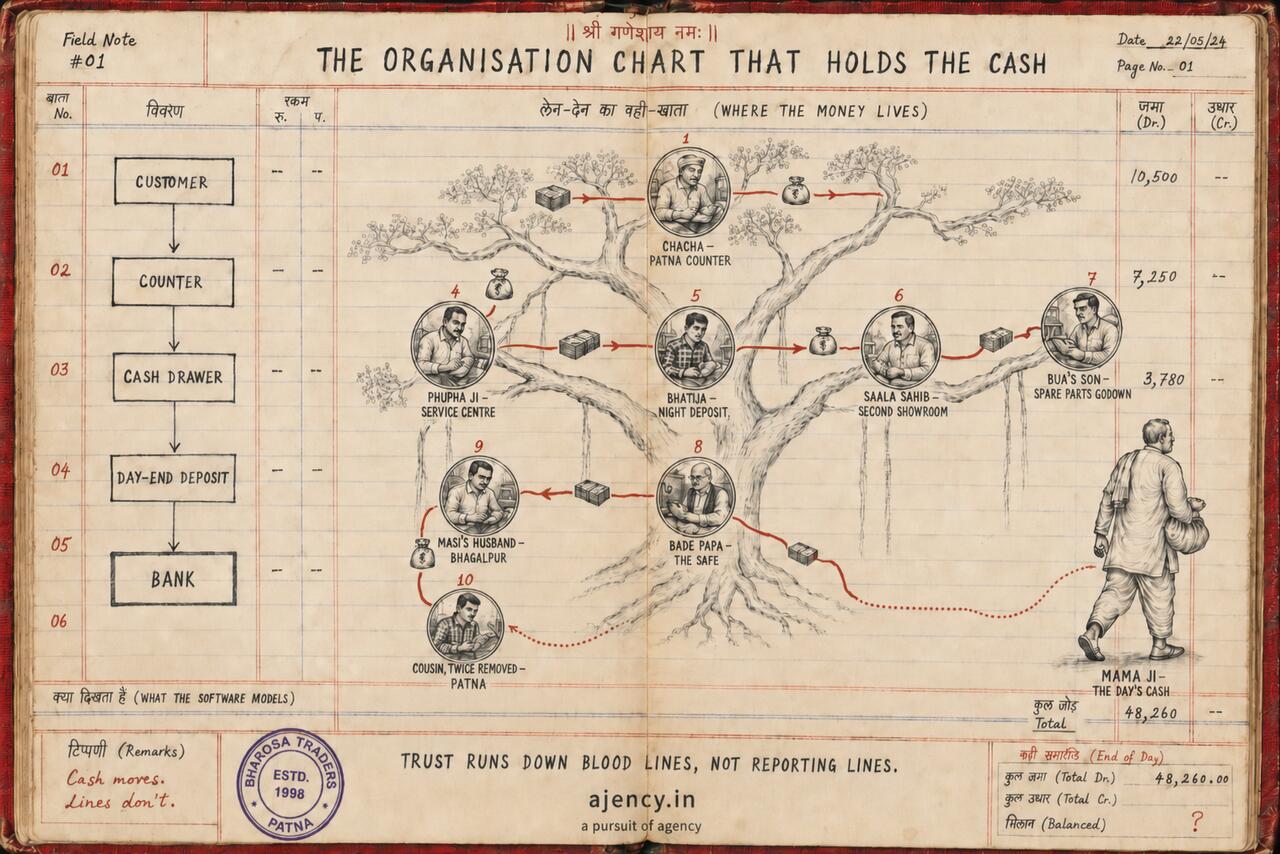
It would be easy to call this the bicycle era, a business allergic to software. But the cash isn't going anywhere: currency in circulation grew 11.9% in FY26, the fastest in five years, and that is in the middle of the UPI decade.
A ₹500-crore-plus auto dealership had asked me for “automation,” and when I pointed them at the usual ERPs the owner's review was one word: stupid. He invited me to sit with his team instead, so I ended up at cash counters across a string of small towns, including Jhumri Telaiya, a place I'd believed was a punchline from Hindi movies.
Jhumri Telaiya
A mica-mining town in eastern India. In the 1950s its listeners flooded Vividh Bharati with film-song requests in such numbers that the name became shorthand on air for “the middle of nowhere” — and stayed a punchline long after most people stopped believing the place existed.
What a “simple” payment looks like
Start with the simplest payment the counter takes. A customer walks up after his car's service, holding a real GST tax invoice, generated by the manufacturer's dealer management system. The carmaker owns it; the dealer merely uses it. There's no API. Getting the data out means someone exporting it by hand.
The cashier takes his payment, writes the UPI reference on the invoice in pen, and waves him through to the gate.
The counter accepted payment for an invoice it didn't create and can't query.
Which vehicle, which bill, how much due, how much collected: every field is a manual entry that can't be verified in real time. A mistake and a theft leave the same trace.
The software has no slot for it
Nothing you can buy off the shelf has a slot for that payment. There are two things you'd reach for, and neither fits.
A POS creates sales, so ringing this up mints a second tax invoice for the same sale.
An accounting package records payments, but a payment needs its invoice in the books first. So someone re-keys every bill into a second system, and the manual-entry gap gets a second address.
Even then, nothing reconciles itself. There's the bank statement, the UPI and card settlement files, the insurer's share of an accident repair, the carmaker's payout on warranty plans, an owner-approved discount handwritten on a tax invoice. Fifteen people match it all by hand, and five more get the result into Tally. It takes a month.
The owner of a ₹500-crore-plus business sees what his cash did four weeks after it did it.
Where does ERP adoption actually die?
Cash custody has no field in the software, and the invoice lives in someone else's system. Both land on the same person: a cashier with a customer waiting and cash in her hand. That is where adoption dies, at the counter, in week one. So she keeps a paper register “just for now.” A year later, everyone agrees the ERP “didn't work here.”
We blame Indian SMBs for poor software adoption. But the business didn't reject the software. The software rejected the business.

The requirements were drawn for a clean world; this dealership grew in the messy one, and the mess is how it works.
So we built it ourselves
We built it, one person and a bench of AI agents, in four months, on one principle: design for the world as you find it. Four rules:
- Record testimony, and make recording it easy. The cashier says what happened; the system doesn't decide what it meant.
- “We don't know yet” is a first-class state. An entry holds there until reconciliation closes it.
- Immutability: nothing recorded is ever edited. Corrections arrive as new entries.
- Reconcile across systems — AI closes most mismatches, people close the rest.
Mama ji still takes the cash home. Nothing about his evening changed. The system finally has the right word for it: custody, with an audit trail.
Next up — “When every source of truth is lying a little”: three systems that never fully agree, and what we do about it.
Get the next post by email.
I publish slowly. You’ll get an email when something new is up.